
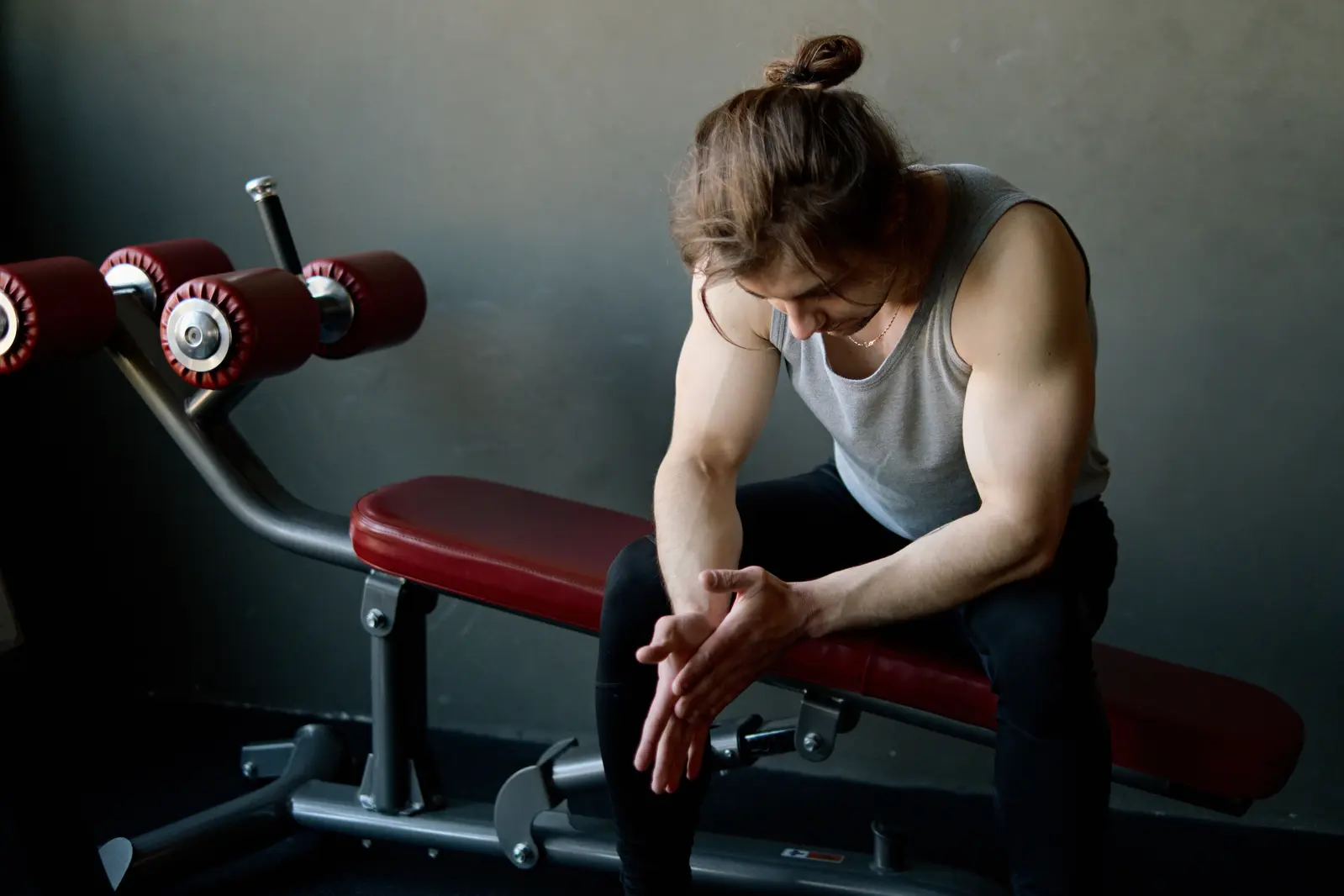
Mild to moderate soreness is generally safe to train through — with reduced intensity or by targeting different muscle groups. Severe soreness that alters your movement mechanics is a signal to rest: compensation patterns raise injury risk more than the soreness itself. That’s the whole answer in two sentences, and it’s more nuanced than either camp — “no pain no gain” or “never train sore” — wants it to be. The interesting question isn’t whether you can train sore; it’s how to read what the soreness is telling you, and how to adjust the session accordingly.
Here’s how to grade your soreness, what the research says training on sore muscles does (and doesn’t do) to recovery, a simple four-option decision tree, and the specific patterns that mean stop.
First, know what you’re dealing with
The soreness in question is DOMS (delayed onset muscle soreness) — the dull, diffuse ache that begins hours after unaccustomed or intense exercise and peaks between 24 and 72 hours later. It comes from the inflammatory repair response to exercise-induced micro-damage, not from ongoing harm — the full mechanism, including why day 2 usually hurts more than day 1, is its own story. What matters for today’s decision is this: DOMS is a repair process in progress, not an injury in progress. As our muscle recovery guide frames it, soreness is information — worth reading, not worth either ignoring or obeying blindly.
That distinction immediately rules out one fear. Reviews of the DOMS literature, including the widely cited work of Cheung, Hume and Maxwell, report no good evidence that exercising a mildly sore muscle worsens the underlying damage or meaningfully delays its repair. Studies from Nosaka and colleagues on exercise-damaged muscle point the same direction: light-to-moderate exercise performed during the soreness window neither amplified damage markers nor slowed recovery. Sore muscle tissue is more resilient than it feels.
So why not just train through everything? Because the same research identifies what soreness does change — and that’s where the real risk lives.
What soreness actually does to your training
Three effects are consistently documented while DOMS is present:
Reduced force output. A sore muscle is temporarily weaker — strength losses during the DOMS window are well established in eccentric-exercise studies, sometimes substantially so after truly novel or brutal sessions. Your planned working weights may simply not be there, and forcing them means grinding reps with compromised tissue capacity.
Altered movement mechanics. This is the one that matters most. Research summarized in the Cheung review suggests that when a muscle is sore and inhibited, the body quietly redistributes the work — changing muscle recruitment sequencing and loading patterns. You squat a little differently, land a little differently, shift load into tissues that weren’t prepared for it. The soreness itself is benign; the compensation is where injury risk concentrates.
Blunted quality, not blocked adaptation. Training sore mostly produces a worse session, not a wasted one. The practical cost is that heavy, technical, or maximal work suffers most — easy and moderate work suffers least. Which conveniently points toward the answer.
The decision tree: four options, one honest self-check
Grade your soreness before the session, using how you move, not just how you feel:
1. Mild soreness — aware of it, but movement is normal. You notice it on stairs; your warm-up feels ordinary once you’re moving. → Train normally. Expect the first sets to feel creaky and improve as you warm up — temporarily reduced soreness during activity is one of DOMS’s most reliable features.
2. Moderate soreness — stiff, but mechanics hold up once warmed. Movement is genuinely affected until you’ve warmed up thoroughly; top-end strength feels dulled. → Train modified. The clean options: hit different muscle groups (sore legs, train upper body — the classic split logic exists for exactly this reason), or train the sore area at reduced intensity — lighter loads, fewer sets, nothing near failure, nothing maximally eccentric-heavy. Skip new exercises and technical maxes; this is not the day to learn anything.
3. Notable soreness, low energy, or peak day-2 misery. → Active recovery. Easy walking, gentle cycling, mobility work — light movement typically eases the sensation of soreness and keeps the week moving without adding recovery debt. This is precisely the job active recovery days are designed for.
4. Severe soreness — your movement visibly changes. You’re descending stairs sideways, wincing into chairs, unable to perform basic patterns without contorting around the pain. → Rest. Not because training would destroy the muscle, but because you cannot move well, and training on distorted mechanics is how a harmless recovery week becomes a genuine injury. One or two days of patience is cheap insurance.
The honest self-check that makes the tree work: warm up first, then decide. Five to ten minutes of easy movement tells you more than any pre-coffee self-assessment. If quality movement shows up, proceed at the level it shows up at. If it doesn’t, downgrade one step.
When soreness is a warning sign
Normal DOMS has a recognizable signature: dull, diffuse, roughly symmetrical across the muscles you trained, worst around day 2, clearly improving by day 3 or 4. Several patterns fall outside that signature and deserve caution rather than a training decision:
- Sharp, stabbing, or localized pain — especially pain you can point to with one finger, or pain that appeared at a specific moment mid-workout.
- Joint pain rather than muscle-belly soreness.
- One-sided pain in a bilateral movement.
- Significant swelling, or soreness still severe beyond about a week.
- Extremely severe soreness with very dark urine after extreme or unaccustomed exertion — a potential sign of rhabdomyolysis, which is a medical emergency, not a rest-day question.
These point toward strain, injury, or worse — and the right response is assessment, not modification.
The bigger pattern: chronic soreness is a programming complaint
If you’re always sore, the question isn’t “should I train today” — it’s “what is my program doing.” Persistent soreness usually means intensity or novelty is spiking faster than the body’s protective adaptation (the repeated bout effect) can keep up, or that sleep, food, or stress are shortchanging recovery between sessions. Training frequency research — including meta-analytic work from Schoenfeld and colleagues — suggests muscle groups can productively be trained multiple times per week when the dose per session is sensible; chronic soreness suggests the dose isn’t. Gradual progression is the most effective soreness-prevention strategy in the literature, unglamorous as that is. And the recovery window this all depends on lengthens with age — the inflammatory response resolves more slowly over the decades, which is part of why recovery changes after 40 and soreness decisions deserve slightly more conservatism there.
Frequently asked questions
Will training sore muscles make them grow slower?
There’s no strong evidence that training through mild-to-moderate soreness impairs muscle growth, and studies on exercising damaged muscle haven’t shown delayed repair from light-to-moderate work. What can slow progress is chronically training the same muscle hard before it has recovered — performance drops, session quality falls, and the stimulus suffers. Train sore muscles gently or train something else; hammering them at full intensity every time is the counterproductive version.
How do I tell soreness from injury?
DOMS is dull, diffuse, spread across the trained muscles, peaks around day 2, and improves steadily. Injury tends to be sharp or localized, often one-sided, frequently traceable to a specific moment, may involve a joint or visible swelling, and doesn’t follow the improving-by-day-3 arc. When a pain fails the DOMS signature on any of those points, treat it as a possible injury and get it assessed rather than training around it.
Should beginners train through soreness?
With extra caution, yes — but at the “train modified” or “active recovery” level, not full intensity. Beginners get the worst DOMS because everything is novel, and they’re also least equipped to distinguish soreness from injury or to notice their own compensation patterns. The good news is the repeated bout effect: the same workouts produce dramatically less soreness within weeks. Early on, gentle movement on sore days plus patient progression beats heroics.
Does soreness mean I need more protein?
Not specifically. Soreness tracks novelty and eccentric stress far more than nutrition status — adequately fed lifters still get wrecked by novel workouts. Sufficient protein supports the repair process overall, and chronically poor intake can slow recovery, but eating extra protein on sore days won’t switch the soreness off. If soreness is constant, look at programming and sleep before the shaker.
Is it OK to work the same muscles two days in a row?
Occasionally and lightly, yes — research doesn’t show that movement per se harms recovering muscle. But two consecutive hard sessions on the same muscle group gives the repair process no window to complete, and session two will be measurably worse anyway due to reduced force output. If you love training daily, alternate muscle groups or alternate hard and genuinely easy days.
Keep reading: the full context for these decisions is in our muscle recovery and mobility guide; to understand what the soreness actually is, see why muscle soreness peaks on day 2; and for what a well-built in-between day looks like, see what to do on active recovery days.
This article is for informational purposes and is not medical advice. If you experience sharp pain, joint pain, significant swelling, pain that worsens rather than improves, or very dark urine after exercise, please seek medical attention promptly.